
A Strange Moment That Starts With a Simple Misstep
It usually begins with something small. A missed step on the stairs, a dropped cup, or a hand that does not move the way it should. At first, it is easy to ignore. You may think it is just fatigue or stress.
However, when these moments start repeating, they raise important questions about how the body controls movement. This is where medical science introduces terms that may sound unfamiliar but are deeply meaningful. One such term is “tax/o.”
On my blog “Highstudios Insights,” the goal is to simplify complex medical language into something practical and understandable. The term “tax/o” is a perfect example of how a small word can explain an essential function of the human body: coordination.
What Does the Medical Term Tax/o Mean?
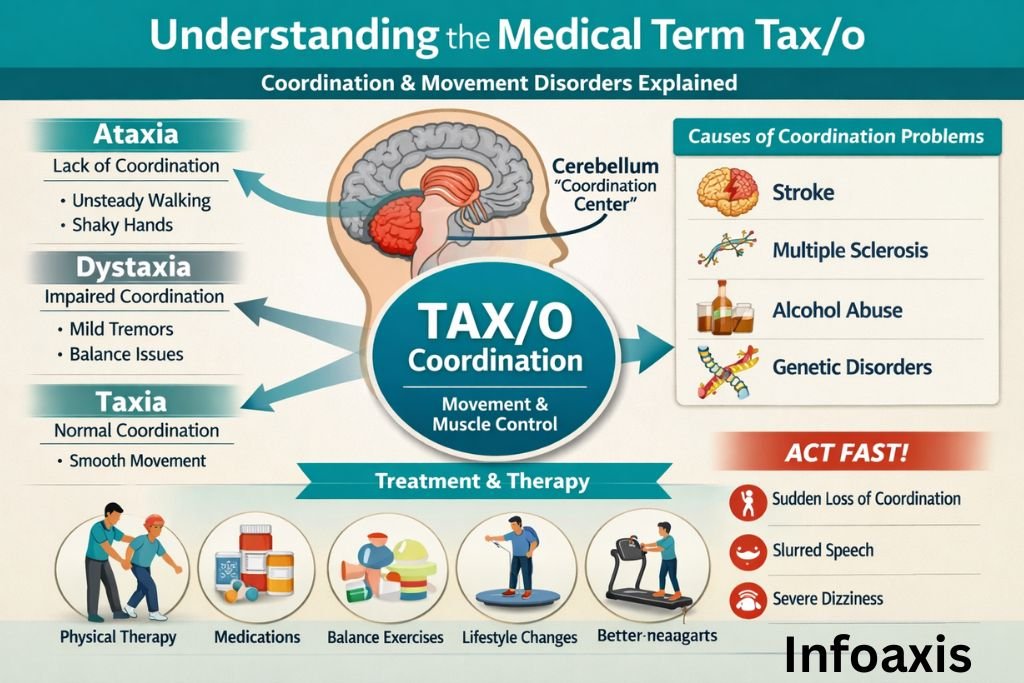
The medical term tax/o refers to coordination or order of movement, particularly how muscles work together smoothly and efficiently.
Understanding the Meaning and Origin of Tax/o
The root “tax/o” comes from the Greek word “taxis,” which means arrangement, order, or coordination. In medical terminology, it is used to describe how the body organizes and controls movement.
You can think of it as a system where the brain directs and the muscles respond. When this system works properly, movements are smooth and controlled. When it does not, coordination problems begin to appear.
Common Medical Terms That Use Tax/o
Ataxia (Lack of Coordination)
Ataxia is formed from the prefix “a-” meaning without, combined with “tax/o” meaning coordination, and the suffix “-ia” meaning condition. It refers to a lack of muscle coordination.
People with ataxia may experience unsteady walking, difficulty with speech, or trouble performing precise tasks such as writing or buttoning a shirt. Everyday activities become challenging because the body cannot coordinate movements properly.
Dystaxia (Impaired Coordination)
Dystaxia combines “dys-” meaning difficult or abnormal with “tax/o.” It refers to partial or impaired coordination rather than a complete loss.
This condition may present as mild tremors, slight imbalance, or inconsistent movement control. While less severe than ataxia, it still affects daily functioning.
Taxia (Normal Coordination)
Taxia refers to normal muscular coordination. Medical professionals may use this term when evaluating a patient’s ability to maintain balance, posture, and controlled movement.
A Real-Life Perspective on Coordination Disorders
Consider the case of Ahmed, a 35-year-old mechanic known for his precision and steady hands. Over time, he began dropping tools and losing balance while walking. Initially, he dismissed these signs as fatigue.
As the symptoms progressed, he sought medical attention and was diagnosed with cerebellar ataxia. This diagnosis explained that his coordination system was no longer functioning properly.
With therapy and adjustments, Ahmed learned to manage his condition. His experience highlights how understanding a term like “tax/o” can provide clarity about real-life health challenges.
Where Is Tax/o Used in Medicine?
The term tax/o is most commonly used in fields that deal with movement and coordination.
Neurology
Focuses on the brain and nervous system, where coordination is controlled.
Physical Therapy
Helps patients regain movement and improve coordination through targeted exercises.
Rehabilitation Medicine
Supports recovery from injuries or conditions such as stroke.
Orthopedics
Deals with the musculoskeletal system and its role in movement.
What Causes Coordination Problems?
Several medical conditions can affect coordination and lead to tax/o-related disorders.
Stroke
A stroke can damage brain areas responsible for movement, resulting in sudden loss of coordination.
Multiple Sclerosis (MS)
MS disrupts communication between the brain and body, leading to coordination issues.
Cerebellar Disorders
The cerebellum is responsible for coordination. Damage to this area directly affects movement control.
Alcohol Abuse
Long-term alcohol use can impair the cerebellum and lead to persistent coordination problems.
Genetic Conditions
Certain inherited disorders, such as Friedreich’s ataxia, cause progressive coordination loss.
What to Do If You Notice Coordination Issues
Recognizing early signs can make a significant difference in treatment outcomes.
Step 1: Observe Symptoms
Pay attention to balance issues, shaky hands, or difficulty with daily tasks.
Step 2: Consult a Doctor
Begin with a general physician, who may refer you to a specialist such as a neurologist.
Step 3: Undergo Diagnostic Tests
These may include neurological exams, imaging scans like MRI, and balance assessments.
Step 4: Begin Treatment
Treatment depends on the cause and may involve medication, therapy, or lifestyle changes.
Step 5: Monitor Progress
Regular follow-ups help track improvement and adjust treatment as needed.
The Role of Physical Therapy
Physical therapy is one of the most effective ways to manage coordination problems. It focuses on improving balance, strengthening muscles, and retraining movement patterns.
Therapists design personalized programs that include practical activities such as walking safely, climbing stairs, and improving hand coordination. These exercises help the brain and body work together more efficiently over time.
When Should You Seek Immediate Medical Help?
Certain symptoms require urgent medical attention. These include sudden loss of coordination, difficulty speaking, vision problems, or severe dizziness.
Such signs may indicate serious conditions like a stroke and should never be ignored.
Who Can Benefit from Understanding Tax/o?
This article is useful for a wide range of readers, including students learning medical terminology, beginners exploring healthcare concepts, medical students, patients experiencing symptoms, and caregivers supporting loved ones.
Understanding this term helps bridge the gap between medical language and real-life health situations.
Why the Medical Term Tax/o Matters
The term tax/o is more than just a definition. It represents the body’s ability to maintain order and coordination in movement.
When this system is disrupted, it affects daily life in noticeable and often challenging ways. Understanding this term allows for better awareness, early detection, and informed decision-making.
Final Thoughts
The medical term tax/o plays a crucial role in describing how the body controls movement and coordination. From conditions like ataxia to everyday motor function, it is central to understanding human health.
If you or someone you know experiences coordination difficulties, it is important to seek medical advice. Early diagnosis and proper care can significantly improve outcomes.
Frequently Asked Questions
What does the medical term tax/o mean?
It refers to coordination or order of movement, especially how muscles work together.
What is ataxia?
Ataxia is a condition involving loss of muscle coordination, affecting balance and movement.
What is the difference between ataxia and dystaxia?
Ataxia is a complete loss of coordination, while dystaxia refers to partial or impaired coordination.
Where is tax/o used in medicine?
It is mainly used in neurology, physical therapy, rehabilitation medicine, and orthopedics.
Can coordination problems be treated?
Yes, treatment depends on the underlying cause and may include therapy, medication, and lifestyle changes.
Is ataxia a serious condition?
It can be serious depending on its cause. Some cases are mild, while others may indicate underlying neurological disorders.
Who should learn about the medical term tax/o?
Students, patients, caregivers, and anyone interested in understanding movement and coordination disorders.
Read More : How Long Can I Live With Pavatalgia
Read More : Decoration Tips Decoradyard













Leave a Reply