
Introduction
In the modern era of communication and information technology, digital signals have become the dominant method for recording, processing, and transmitting data. From internet communication and mobile networks to medical imaging and satellite systems, digital technology underpins nearly every aspect of contemporary life. The widespread adoption of digital signals is not accidental; it is driven by their exceptional accuracy, reliability, and efficiency compared to traditional analog systems. This article explores the fundamental reasons why digital signals are considered a highly dependable medium for recording and transmitting information.
Understanding Digital Signals
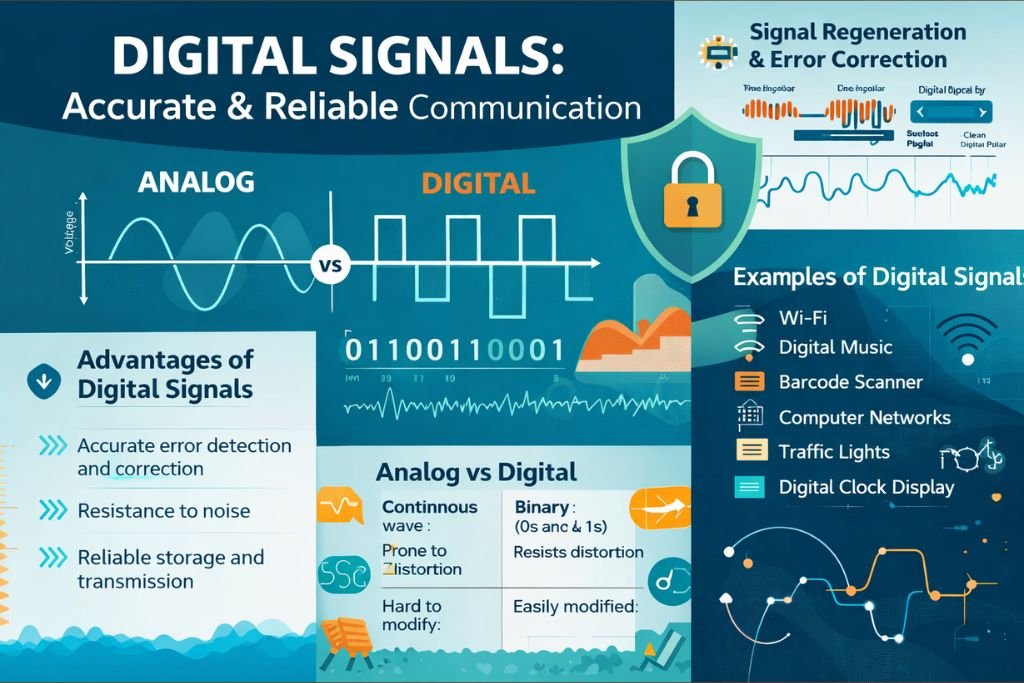
Digital signals represent information using discrete values, typically in binary form (0s and 1s). Unlike analog signals, which vary continuously and can take on an infinite range of values, digital signals operate within clearly defined states. This discrete nature is the foundation of their accuracy and resilience.
1. High Resistance to Noise and Interference
One of the most significant advantages of digital signals is their robustness against noise and interference.
In analog systems, even a small amount of noise can distort the signal, leading to a gradual degradation of quality. However, digital signals are designed with threshold levels that distinguish between binary states. As long as the signal remains within acceptable limits, it can be correctly interpreted.
This means that:
- Minor distortions do not affect the final output
- Signals can travel through noisy environments with minimal loss of information
- Communication remains stable even in challenging conditions
As a result, digital systems provide consistent performance in environments where analog systems would fail.
2. Error Detection and Correction Mechanisms
Digital communication systems incorporate advanced techniques to ensure data integrity.
Methods such as:
- Parity checks
- Checksums
- Cyclic Redundancy Checks (CRC)
- Error-correcting codes (e.g., Hamming codes, Reed-Solomon codes)
allow systems to detect and often correct errors that occur during transmission.
These mechanisms ensure that:
- Corrupted data can be identified instantly
- Errors can be corrected automatically or retransmitted
- Data accuracy is maintained even over long distances
This capability significantly enhances reliability, especially in critical applications such as financial transactions and scientific data transmission.
3. Signal Regeneration and Long-Distance Transmission
As signals travel, they naturally weaken due to attenuation and environmental factors. In analog systems, amplifiers boost both the signal and the noise, leading to cumulative distortion.
Digital systems, however, use repeaters and regenerators that:
- Reconstruct the original binary signal
- Remove accumulated noise
- Restore signal strength without distortion
This process enables digital signals to maintain their integrity over vast distances, making them ideal for global communication networks such as the internet and satellite systems.
4. Accurate and Durable Data Storage
Digital signals are highly effective for data storage due to their stability and precision.
Key advantages include:
- No gradual degradation over time (unlike analog media such as tapes)
- Exact retrieval of stored data
- High-density storage capabilities
Digital data can be stored on various media, including hard drives, solid-state drives, optical discs, and cloud systems. Additionally, advanced compression techniques allow large amounts of data to be stored efficiently without significant loss of quality.
5. Perfect Reproducibility
Another defining feature of digital systems is their ability to produce exact copies.
When digital data is duplicated:
- The copy is identical to the original
- No loss of quality occurs, regardless of the number of copies
- Data integrity is preserved across multiple generations
In contrast, analog duplication introduces noise and distortion with each copy. This makes digital signals far more reliable for archiving, distribution, and backup purposes.
6. Enhanced Security Through Encryption
Digital signals support sophisticated encryption techniques that ensure data security during transmission and storage.
Encryption methods such as:
- Advanced Encryption Standard (AES)
- Rivest-Shamir-Adleman (RSA)
protect information from unauthorized access.
This ensures:
- Confidentiality of sensitive data
- Protection against cyber threats
- Secure communication in applications like online banking, government systems, and healthcare
Security contributes directly to reliability by ensuring that the information received is both accurate and authentic.
7. Efficient Data Compression and Transmission
Digital signals allow for efficient data compression, reducing the size of files without significantly affecting quality.
Examples include:
- Audio compression (MP3, AAC)
- Image compression (JPEG, PNG)
- Video compression (MP4, H.264, H.265)
Compression enables:
- Faster transmission speeds
- Reduced bandwidth usage
- Efficient storage
This efficiency enhances the reliability of data transmission, particularly in bandwidth-limited environments.
8. Integration with Modern Technology
Digital signals are inherently compatible with modern electronic systems.
Devices such as:
- Computers
- Smartphones
- Communication networks
- Embedded systems
are designed to process digital data.
This compatibility allows for:
- Automation and real-time processing
- Integration with artificial intelligence and machine learning
- Scalability and adaptability in evolving technologies
As a result, digital systems are not only reliable but also future-proof.
9. Flexibility in Transmission Media
Digital signals can be transmitted through a wide variety of media, including:
- Copper cables (Ethernet)
- Fiber optic cables (high-speed internet)
- Wireless systems (Wi-Fi, Bluetooth, cellular networks)
- Satellite communication
This flexibility ensures that digital communication can be adapted to different environments and requirements while maintaining reliability.
Conclusion
Digital signals have revolutionized the way information is recorded and transmitted by offering unparalleled accuracy and reliability. Their resistance to noise, ability to detect and correct errors, capacity for signal regeneration, and support for secure and efficient data handling make them superior to analog systems.
In a world increasingly dependent on precise and secure information exchange, digital signals provide the foundation for modern communication systems. Their continued development and integration into emerging technologies ensure that they will remain essential for accurate and reliable data transmission in the future.














Leave a Reply