
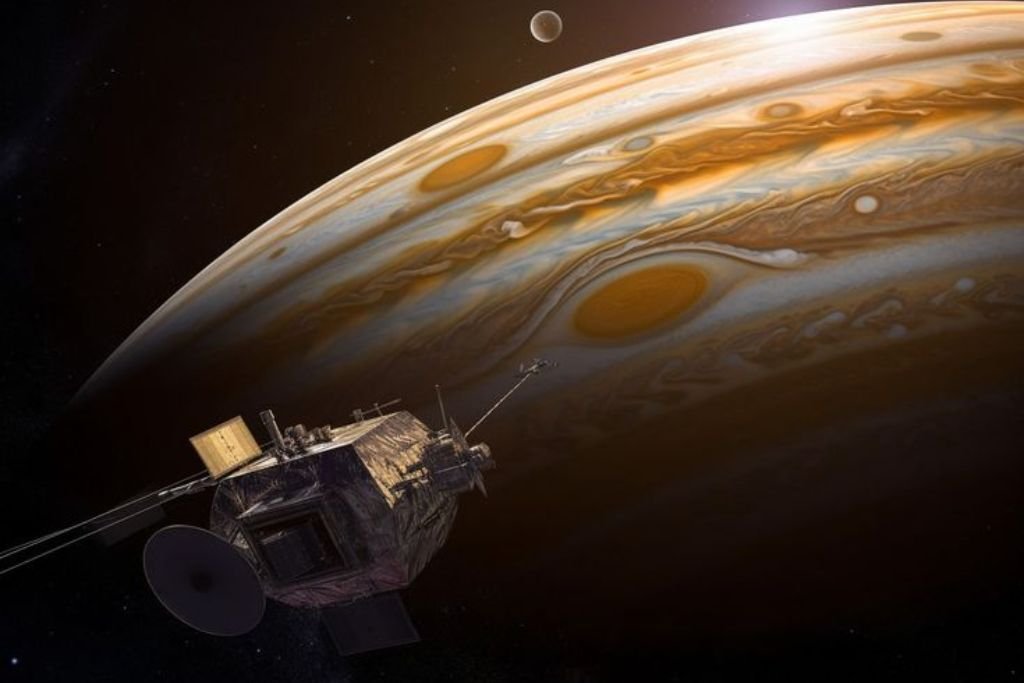
The outer Solar System has long fascinated scientists, particularly the giant planet Jupiter and its intriguing moons. Among these, the icy moons — Ganymede, Europa, and Callisto — are some of the most mysterious worlds, holding the potential for subsurface oceans and even the conditions for life. To explore these distant worlds, the European Space Agency (ESA) launched the Jupiter Icy Moons Explorer, or JUICE, one of the most ambitious planetary missions of the 21st century.
You May Also Read About: OT7 Quanny Age
What Is the Jupiter Icy Moons Explorer (JUICE)?
JUICE is an ESA-led mission designed to study Jupiter and its icy moons in unprecedented detail. The mission launched on 14 April 2023 from the European Spaceport in Kourou, French Guiana, using an Ariane 5 rocket. JUICE is not just another spacecraft; it is a sophisticated orbiter and a flyby explorer, set to conduct multiple scientific observations over a multi-year journey to the Jupiter system. Its primary focus is to explore the three Galilean moons most likely to harbor subsurface oceans: Ganymede, Europa, and Callisto.
Mission Objectives
The JUICE mission is designed with three core scientific goals:
1. Understanding Jupiter’s System
JUICE will investigate Jupiter’s atmosphere, magnetosphere, and radiation environment. By studying the planet’s magnetic field, plasma interactions, and atmospheric dynamics, scientists hope to better understand how gas giants form and evolve. Jupiter’s immense magnetic field and complex auroras make it a natural laboratory for studying planetary magnetospheres.
2. Exploring the Icy Moons
The icy moons of Jupiter have captivated scientists for decades. Europa, with its smooth icy surface, may have a global ocean beneath, kept liquid by tidal forces from Jupiter’s gravity. Ganymede, the largest moon in the Solar System, is unique because it has its own magnetic field. Callisto, heavily cratered and ancient, provides clues about the early Solar System. JUICE will study these moons’ surfaces, ice layers, subsurface oceans, and potential habitability.
3. Investigating Potential Habitability
One of JUICE’s most exciting missions is searching for signs of life or conditions suitable for life. By mapping surface compositions, detecting organic molecules, and studying the moons’ interactions with Jupiter’s magnetic field, JUICE may reveal environments where life could exist.
Scientific Instruments Onboard JUICE
To achieve its goals, JUICE carries a suite of 10 scientific instruments:
- Visible and Infrared Spectrometers: Map surface compositions and detect minerals and ices.
- Magnetometer: Measures magnetic fields and explores subsurface oceans.
- Laser Altimeter: Creates high-resolution topography maps of the moons.
- Plasma and Particle Detectors: Examine charged particles in Jupiter’s magnetosphere.
- Radio Science Experiments: Investigate interior structures and gravitational fields.
These instruments will collectively provide the most detailed dataset ever obtained for Jupiter and its moons.
Mission Timeline
JUICE’s journey is carefully planned, utilizing gravity assists to reach Jupiter efficiently:
- 2023: Launch from French Guiana.
- 2024–2029: Flybys of Earth and Venus for gravity assists.
- July 2031: Arrival at Jupiter.
- 2031–2034: Flybys of Europa, Callisto, and Ganymede.
- 2034 onward: JUICE enters orbit around Ganymede, becoming the first spacecraft to orbit a moon other than Earth’s.
This extended mission duration allows JUICE to gather a wealth of scientific information, enabling comparisons between different moons and Jupiter itself.
Key Discoveries Expected
JUICE is poised to make groundbreaking discoveries in multiple areas:
- Surface Composition: Detailed mapping will reveal ice types, salts, and organic compounds.
- Subsurface Oceans: Magnetic and gravitational studies will help estimate ocean depth and salinity.
- Atmospheric Dynamics: Observations of Jupiter’s radiation belts, auroras, and atmosphere will improve models of gas giants.
- Magnetosphere Interactions: Understanding how Jupiter’s magnetic field interacts with its moons may provide insight into habitability.
Even during its journey, JUICE has the capability to observe interstellar objects, demonstrating its versatility.
Why JUICE Is Significant
JUICE is more than a space mission; it is a gateway to understanding the outer Solar System. By orbiting Ganymede and performing multiple flybys of Europa and Callisto, it will provide the first detailed look at these moons’ geology, chemistry, and potential for life. The data collected will serve as a foundation for future exploration missions, both to Jupiter and beyond.
JUICE will also mark the first time a spacecraft orbits a moon other than Earth’s, setting a historic precedent in planetary exploration. Its findings may even guide the search for habitable worlds around other stars.
Conclusion
The Jupiter Icy Moons Explorer (JUICE) represents a milestone in human space exploration. From studying Jupiter’s complex environment to investigating the icy moons that may harbor life, JUICE is poised to revolutionize our understanding of the outer Solar System. As the spacecraft continues its journey, the world waits with anticipation for the incredible discoveries that lie ahead.
For more fascinating space science articles and updates on missions like JUICE, visit Infoaxis.





Leave a Reply