
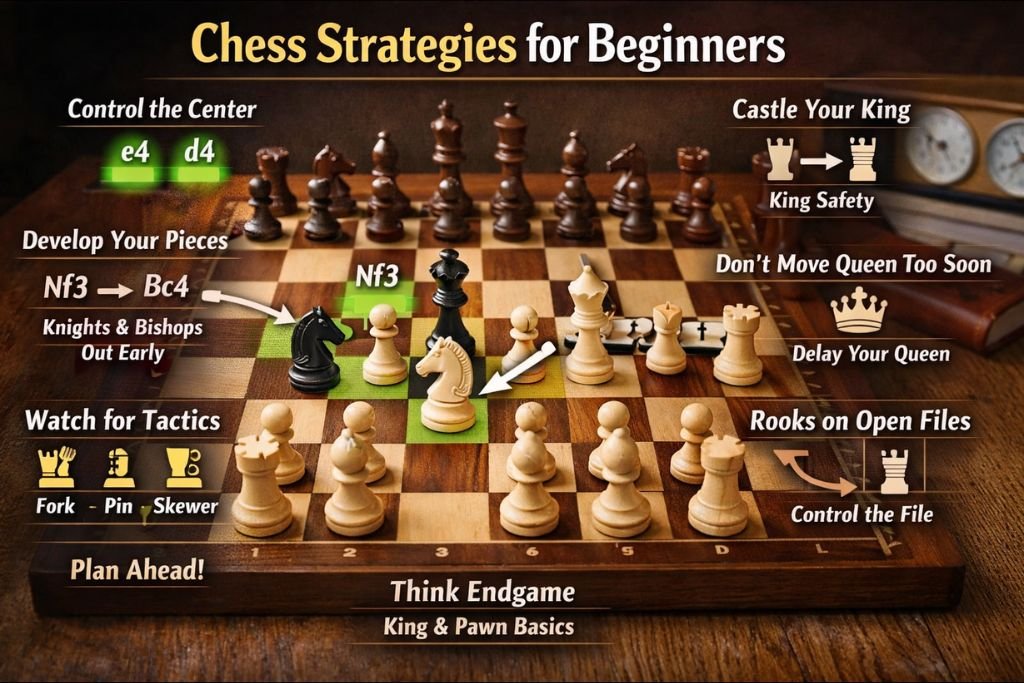
Chess is one of the most popular and intellectually stimulating games in the world. Known as the “game of kings,” it challenges players to think strategically, anticipate opponents’ moves, and develop both short-term tactics and long-term plans. For beginners, the game can seem overwhelming at first, but understanding fundamental chess strategies can dramatically improve your performance and enjoyment. This guide will cover essential strategies for beginners, from opening moves to endgame tips.
You May Also Read About: How to Remove Background in Canva
Understanding the Basics
Before diving into strategies, beginners should familiarize themselves with the basic rules of chess. Each player starts with 16 pieces: one king, one queen, two rooks, two knights, two bishops, and eight pawns. The objective is to checkmate the opponent’s king — that is, to put it under threat of capture with no legal moves remaining. Beyond the rules, understanding chess strategies allows players to play with purpose, rather than making random moves.
1. Control the Center
Controlling the center of the board is a foundational strategy in chess. The central squares — d4, d5, e4, and e5 — allow your pieces to move freely across the board. Occupying or influencing these squares gives you both offensive and defensive advantages.
How to Control the Center:
- Use pawns to occupy central squares, such as moving e4 or d4 on your first turn.
- Develop knights to f3 or c3 (for White) and f6 or c6 (for Black), where they influence central squares.
- Avoid moving the same piece multiple times in the opening unless necessary; focus on quick development.
Controlling the center ensures that your pieces have maximum mobility and prepares you for both attacking and defending.
2. Develop Your Pieces Efficiently
Piece development refers to moving your minor pieces (knights and bishops) from their starting squares to active positions. Beginners often make the mistake of moving the queen too early or advancing too many pawns, which can slow down their development and expose them to attacks.
Development Tips:
- Move knights and bishops before bringing out your queen.
- Avoid moving the same piece multiple times in the opening.
- Prepare to connect your rooks by castling and moving your queen at the right time.
Example of beginner-friendly development:
1. e4 e5
2. Nf3 Nc6
3. Bc4
This is known as the Italian Game, which develops pieces and controls the center efficiently.
3. Ensure King Safety — Castle Early
A common beginner mistake is neglecting king safety. Castling is a critical move that protects your king and brings your rook into play.
Castling Rules:
- You can castle kingside (short) or queenside (long) if neither the king nor the rook has moved and there are no pieces between them.
- Castling early is generally recommended to secure your king and coordinate your rooks.
Remember: an exposed king can quickly lead to losing the game, no matter how well your other pieces are developed.
4. Avoid Moving the Queen Too Soon
The queen is your most powerful piece, but bringing her out early can be risky. Early queen moves often make her a target for minor pieces, forcing you to move her repeatedly and lose valuable development time. Prioritize developing knights and bishops first, and only bring out your queen once your other pieces are active.
5. Coordinate Your Pieces
Chess is a team game. Your pieces must work together rather than act independently. Coordinating pieces effectively strengthens both your attack and defense.
Coordination Tips:
- Use knights to support bishops and vice versa.
- Position rooks on open files to control key areas of the board.
- Keep your pawns structured to protect your pieces.
A coordinated army of pieces can launch powerful attacks and defend weak points efficiently.
6. Learn Basic Tactics
Tactics are short-term maneuvers that create immediate opportunities to gain an advantage. Beginners should focus on recognizing and practicing basic tactical patterns, such as:
- Forks: One piece attacks two or more of the opponent’s pieces simultaneously.
- Pins: A piece is immobilized because moving it would expose a more valuable piece.
- Skewers: A high-value piece is forced to move, exposing a lower-value piece.
- Discovered Attacks: Moving one piece reveals another piece attacking the opponent.
Practicing these tactics regularly helps beginners spot opportunities and threats quickly.
7. Plan Ahead
Thinking one move ahead is not enough; beginners should try to anticipate several moves in advance. A good plan takes into account your objectives, your opponent’s threats, and the coordination of your pieces.
Questions to Ask Yourself:
- What is my opponent threatening?
- Are any of my pieces under attack?
- Which pieces are active, and which need improvement?
- What is my overall goal — attacking, defending, or controlling space?
Planning helps avoid random moves and improves decision-making throughout the game.
8. Don’t Lose Material Unnecessarily
Losing pieces without compensation is a common reason beginners struggle. Before exchanging pieces, assess whether the trade benefits you. Always consider:
- The value of the pieces involved.
- Potential threats after the exchange.
- Whether the trade improves your position.
Retaining material advantage is often key to winning games.
9. Rooks on Open Files
Rooks are most effective when placed on open files (columns without pawns). Open files allow rooks to penetrate the opponent’s position and support other pieces in both attack and defense.
10. Endgame Fundamentals
Many beginners focus on openings and middlegame tactics but neglect endgames. Understanding basic endgame principles is essential for converting an advantage into victory.
Key Endgame Tips:
- Activate your king — in endgames, the king becomes a strong piece.
- Promote pawns strategically to queens or other pieces.
- Learn basic mating patterns (e.g., king + rook vs. king).
Endgame knowledge often distinguishes beginners from more advanced players.
Practical Tips for Beginners
- Play longer games: Rapid or classical time controls give you more time to think strategically.
- Review your games: Identify mistakes and missed opportunities.
- Solve tactical puzzles: Daily practice sharpens your tactical vision.
- Learn from losses: Analyze why you lost, and what could have been done differently.
Suggested Beginner Openings
Italian Game
1. e4 e5
2. Nf3 Nc6
3. Bc4
- Focuses on rapid development and center control.
Queen’s Gambit
1. d4 d5
2. c4
- Offers a pawn to gain control of the center, excellent for beginners learning strategic play.
Conclusion
Chess is a game that rewards patience, planning, and practice. Beginners who master the fundamentals — controlling the center, developing pieces, protecting the king, coordinating pieces, and understanding tactics — will see rapid improvement. Remember, every game is a learning opportunity. With dedication and consistent practice, even new players can develop strong strategic skills and enjoy the rich depth that chess offers.














Leave a Reply