
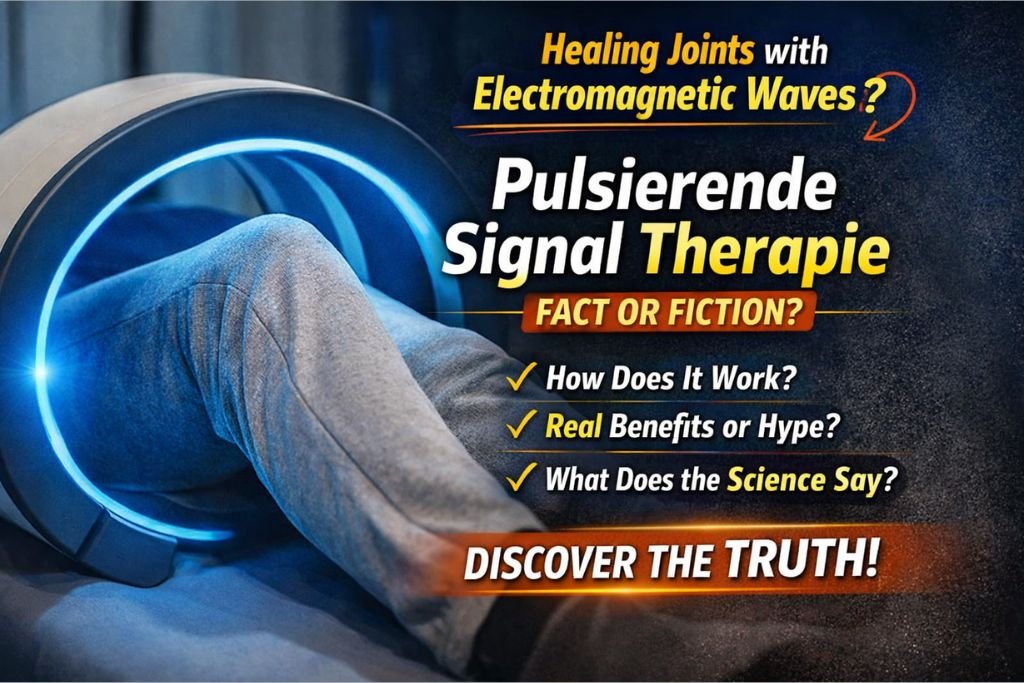
The room is quiet. No surgical lights. No whirring drills. No sharp scent of disinfectant hanging in the air. A patient lies comfortably on a treatment couch while a sleek ring-shaped device is positioned around their aching knee. There is no pain, no vibration, not even a noticeable sensation. And yet, something is happening — invisible waves pulsing rhythmically through cartilage and bone.
This is Pulsierende Signal Therapie (PST) — a therapy built not on scalpels or pharmaceuticals, but on the subtle language of electromagnetic signals.
For some, it represents the future of regenerative medicine. For others, it remains a controversial branch of alternative therapy still awaiting robust scientific validation. What is undeniable, however, is that PST occupies a fascinating intersection between physics, biology, and hope.
Let us step into this world of invisible signals and explore what PST truly is, how it works, what science says about it — and why it continues to attract both patients and debate.
You May Also Read About: How to Alphabetize Apps on Android
The Origin of an Idea: When Physics Meets Biology
Every cell in the human body communicates through electrical impulses. From the firing of neurons in the brain to the contraction of muscle fibers, bioelectric signals form the hidden orchestra of life. Even cartilage — often thought of as inert cushioning tissue — responds to mechanical and electrical stimuli.
The conceptual foundation of Pulsierende Signal Therapie rests on a compelling idea:
If cells rely on electrical signals to regulate healing and regeneration, could externally applied electromagnetic pulses stimulate repair in damaged tissues?
PST emerged from research into pulsed electromagnetic field therapy (PEMF), a broader medical field that has been studied for decades, particularly in bone healing. Certain PEMF devices are even approved in various countries for supporting bone fracture healing and non-union fractures.
PST represents a specialized application of this principle — focusing especially on cartilage, joints, and degenerative musculoskeletal conditions.
What Exactly Is Pulsierende Signal Therapie?
Pulsierende Signal Therapie (translated as Pulsating Signal Therapy) is a non-invasive treatment method that uses low-frequency pulsed electromagnetic fields to stimulate biological processes within tissues.
Unlike continuous electromagnetic exposure, PST uses carefully timed pulses — specific frequencies and intensities designed to interact with cells without generating heat or discomfort.
The Technical Framework
During treatment:
- The affected body part (for example, a knee, hip, or shoulder) is placed within a coil or applicator.
- The device emits low-frequency magnetic pulses.
- These pulses penetrate deep into tissue — including cartilage and bone.
- No physical sensation is typically felt.
A standard PST treatment course often involves:
- 9 to 12 sessions
- Approximately one hour per session
- Conducted over consecutive days or weeks
There is no downtime, no anesthesia, and no surgical intervention.
On the surface, it appears almost too simple.
But beneath the surface lies a complex biological theory.
The Biological Hypothesis: Can Signals Restore Cellular Rhythm?
Proponents of PST suggest that injured or degenerating tissues lose their optimal electrical communication patterns. In osteoarthritis, for example, cartilage cells (chondrocytes) struggle to maintain matrix production and structural integrity.
The hypothesis is that:
- Pulsed electromagnetic fields may influence cell membrane potentials.
- They may affect ion channels and calcium signaling.
- They may enhance microcirculation.
- They may stimulate metabolic activity within cartilage cells.
In simple terms, PST aims to “remind” cells how to function properly — by restoring the electromagnetic cues that guide repair.
While this explanation is compelling, it is important to emphasize that much of this mechanism remains theoretical or partially supported by laboratory data. Human clinical outcomes are more complex.
Conditions Commonly Treated with PST
PST is most frequently promoted for musculoskeletal disorders, particularly those involving degeneration or chronic pain.
1. Osteoarthritis (Arthrose)
Perhaps the most common indication. Osteoarthritis involves cartilage breakdown, stiffness, inflammation, and pain. PST is marketed as a therapy that may:
- Reduce pain
- Improve joint mobility
- Slow degenerative progression
- Support cartilage metabolism
2. Sports Injuries
Athletes sometimes turn to PST for:
- Ligament strains
- Tendon injuries
- Overuse syndromes
- Recovery support
3. Chronic Back and Neck Pain
Degenerative spinal conditions are another frequent target.
4. Tendinopathies and Connective Tissue Disorders
Some practitioners apply PST to support healing in tendons and fascia.
The Patient Experience: Why Many Are Drawn to PST
There is something deeply appealing about a therapy that:
- Is painless
- Requires no medication
- Has minimal reported side effects
- Feels technologically advanced
- Promises regeneration rather than symptom suppression
In a world where joint replacement surgeries are common and chronic pain often leads to long-term medication use, PST offers a narrative of gentle stimulation and natural healing.
Many patients report subjective improvements in:
- Pain intensity
- Range of motion
- Functional capacity
- Overall quality of life
However, patient testimonials, while meaningful, are not substitutes for rigorous clinical evidence.
What Does Science Say?
Here lies the heart of the debate.
Evidence Landscape
PST is part of the broader category of PEMF therapies. Research on PEMF has shown:
- Evidence supporting use in bone fracture healing
- Some studies suggesting pain reduction in osteoarthritis
- Mixed results regarding cartilage regeneration
However, when focusing specifically on PST-branded treatments:
- Many clinical trials are small.
- Methodological quality varies.
- Large-scale independent replication studies are limited.
- Some systematic reviews conclude evidence remains insufficient for definitive recommendations.
Medical evaluation bodies in several countries have expressed skepticism due to limited high-quality randomized controlled trials.
This does not necessarily mean PST is ineffective — but it does mean that stronger, more rigorous research is needed.
Supporters vs. Critics
Supporters Argue:
- PST is safe and non-invasive.
- Patients report real pain relief.
- Biological plausibility exists through electromagnetic signaling research.
- It may reduce reliance on pain medication.
Critics Emphasize:
- Lack of strong double-blind, placebo-controlled trials.
- Potential placebo effects.
- High treatment costs.
- Limited insurance coverage in many regions.
The tension between innovation and evidence continues.
Safety and Contraindications
One of PST’s strengths is its safety profile.
Because it uses low-intensity electromagnetic pulses:
- It does not generate harmful radiation.
- It does not produce tissue heating.
- Side effects are rare.
However, it is generally contraindicated in:
- Patients with pacemakers or implanted electronic devices
- Pregnancy
- Active tumors in the treatment area
- Acute infections
Medical consultation is always recommended.
PST in the Context of Modern Medicine
We are living in an era of regenerative medicine — stem cell therapy, platelet-rich plasma, tissue engineering. PST fits into this broader aspiration: stimulating the body rather than replacing it.
The question is not whether electromagnetic fields can influence biological systems — that is well established in physics and cellular biology.
The question is:
Can we harness those effects in a predictable, clinically meaningful way for cartilage and joint disease?
That answer remains in progress.
A Therapy at the Crossroads
Pulsierende Signal Therapie stands at a fascinating crossroads:
- Between physics and physiology
- Between promise and proof
- Between innovation and skepticism
For patients seeking non-surgical options for chronic joint pain, PST represents hope — hope delivered not by chemical compounds or surgical steel, but by invisible pulses of energy.
For scientists and clinicians, it remains a field demanding more rigorous investigation.
The Final Pulse: Hope, Evidence, and the Future
Imagine a future where joint degeneration could be slowed without surgery. Where electromagnetic patterns could guide tissue repair like a conductor guiding an orchestra. Where healing would not require cutting, only signaling.
That is the vision PST embodies.
Whether it ultimately fulfills that vision depends not on marketing claims, but on careful research, transparent data, and long-term clinical outcomes.
Until then, Pulsierende Signal Therapie remains a compelling story — one written in waves you cannot see, but can perhaps one day measure with certainty.
And in medicine, as in physics, sometimes the most powerful forces are the ones we cannot see — only study, question, and continue to explore.












Leave a Reply