

Introduction
The matchup between the Cincinnati Bengals and the Green Bay Packers on October 10, 2021 remains one of the most exciting regular-season games in recent NFL history. Fans and analysts alike often search for “Bengals vs Green Bay Packers match player stats” hoping to understand not just the numbers, but the context behind those numbers—how they reflect momentum, strategy, and individual impact.
This article takes a deep dive into player performances, team-level statistics, and hidden factors that influenced the game. Instead of just listing raw statistics, we will explore what these numbers truly mean in terms of player impact, game flow, and future insights for fans, fantasy football players, and analysts.
You May Also Read About: Phillies vs Cubs
Match Context and Why This Game Still Matters
The 2021 Bengals vs Packers game was more than just another regular-season matchup. It was a turning point for Cincinnati, showcasing Joe Burrow’s growth after a major injury, while also testing Green Bay’s reliance on veteran quarterback Aaron Rodgers.
Key context points include:
- Cincinnati Bengals: Transitioning from a rebuilding team to a competitive AFC contender. Burrow was playing his first full season after recovering from a significant knee injury.
- Green Bay Packers: Relied heavily on Aaron Rodgers’ efficiency, veteran experience, and ability to read defenses pre-snap.
- Game dynamics: Multiple missed field goals created extended offensive drives, inflating certain player statistics while adding drama to the matchup.
Understanding these points is critical because statistics do not exist in isolation. Pressure situations, game flow, and situational football heavily influenced how both teams’ numbers came about.
Team-Level Statistical Overview
Before diving into individual performances, it is helpful to examine the team-level statistics to understand the broader context of the game.
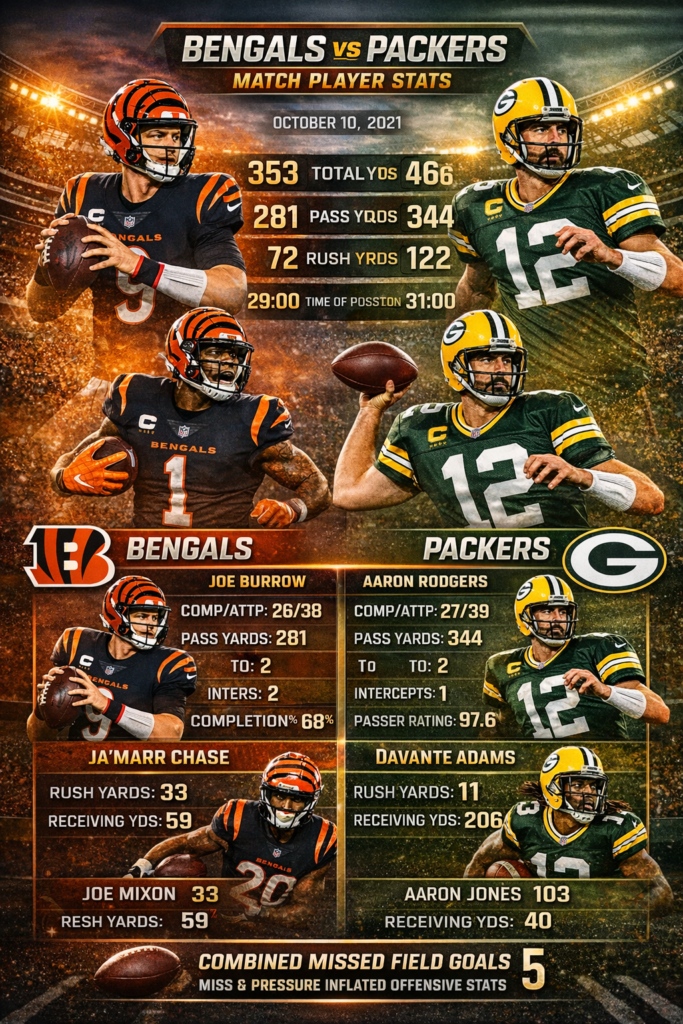
| Statistic | Cincinnati Bengals | Green Bay Packers |
|---|---|---|
| Total Yards | 353 | 466 |
| Passing Yards | 281 | 344 |
| Rushing Yards | 72 | 122 |
| Time of Possession | 29:00 | 31:00 |
Analysis:
While the Packers dominated in total yardage and had a slight edge in time of possession, the Bengals remained competitive due to explosive passing plays and red zone efficiency. The Bengals’ ability to convert big plays kept the game within reach, ultimately pushing it to overtime.
Offensive Comparison
Cincinnati Bengals
- Passing-first offense: 281 passing yards, 26 completions on 38 attempts
- Rushing support: 72 rushing yards
- Explosive plays: Ja’Marr Chase’s deep threat ability and Tee Higgins’ red zone dominance made the passing game lethal.
Green Bay Packers
- Balanced attack: 344 passing yards and 122 rushing yards
- Efficient quarterback play: Aaron Rodgers managed the offense with precision, exploiting mismatches and reading blitzes effectively.
- Rushing contribution: Aaron Jones’ 103 rushing yards helped maintain tempo and prevent the Bengals from focusing solely on the pass.
Defensive Snapshot
Both teams’ defenses had notable moments:
- Bengals defense: Generated key stops on third downs late in regulation, keeping Green Bay from closing the game quickly.
- Packers defense: Applied pressure but struggled against intermediate passing routes.
- Overall trends: Both defenses allowed over 5 yards per play, emphasizing that offensive execution dominated the matchup.
Cincinnati Bengals Player Stats Analysis
Joe Burrow – Quarterback Performance
- Completions / Attempts: 26 / 38
- Passing Yards: 281
- Touchdowns: 2
- Interceptions: 2
- Completion Percentage: 68%
Burrow demonstrated pocket composure against a defense that disguised coverages effectively. While his two interceptions came from aggressive decisions rather than poor mechanics, his performance on third downs was exceptional, using timing routes and quick releases to keep drives alive.
Bengals Wide Receivers Impact
Ja’Marr Chase
- Receptions: 6
- Yards: 159
- Touchdowns: 1
- Yards per Catch: 26.5
Chase’s deep threat ability forced the Packers to play softer coverage, creating opportunities underneath for other receivers. His explosive plays shifted defensive focus and significantly influenced game dynamics.
Tee Higgins
- Receptions: 6
- Yards: 60
- Touchdowns: 2
Higgins excelled in the red zone, allowing Burrow to trust contested throws and secure critical scores. His presence complemented Chase, providing balance between intermediate and deep threats.
Running Game and Supporting Cast
Joe Mixon
- Rushing Attempts: 10
- Rushing Yards: 33
- Receiving Yards: 59
Although Mixon did not produce massive rushing numbers, his contributions in pass protection and as a receiving option were critical to sustaining drives. The Bengals’ offensive line improved as the game progressed, allowing Burrow a cleaner pocket, especially in overtime.
Green Bay Packers Player Stats Analysis
Aaron Rodgers – Masterclass in Control
- Completions / Attempts: 27 / 39
- Passing Yards: 344
- Touchdowns: 2
- Interceptions: 1
- Passer Rating: 97.6
Rodgers delivered a statistically complete game, using pre-snap adjustments to exploit defensive weaknesses. His single interception was from a tipped ball, and his clock management in late regulation directly led to scoring opportunities.
Packers Receiving Leaders
Davante Adams
- Receptions: 11
- Yards: 206
- Touchdowns: 1
Adams’ precision in route running forced the Bengals to shift to zone coverage late in the game. He consistently drew defensive attention, creating openings for other Packers receivers.
Allen Lazard
- Receptions: 2
- Yards: 13
- Touchdowns: 1
Lazard’s touchdown came on a designed red zone play, capitalizing on overcommitment to Adams, highlighting the Packers’ strategic utilization of personnel.
Rushing Attack Contribution
Aaron Jones
- Rushing Yards: 103
- Receiving Yards: 40
Jones provided balance to the Packers’ offense, ensuring the Bengals could not solely focus on defending the pass. His efficiency on early downs helped control game tempo and sustain drives.
Special Teams and Hidden Statistical Factors
Special teams had a significant impact on this game:
- Combined missed field goals: 5
- Impact: Extended drives and inflated passing/receiving stats, slightly skewing traditional efficiency metrics.
These missed kicks were critical in pushing the game into overtime, demonstrating that hidden factors can heavily influence player stats.
Key Statistical Takeaways
From this matchup, several insights stand out:
- Explosive plays outweighed time of possession in determining momentum.
- Quarterback decision-making had a greater effect than raw yardage.
- Red zone efficiency was the differentiator among top receivers.
- Defensive fatigue influenced overtime outcomes.
These takeaways show that stats alone do not tell the full story—context is essential.
Real-World Applications of These Player Stats
Fantasy Football Insights
- Prioritize receivers with high yards per catch, not just volume.
- Quarterbacks with late-game composure are safer playoff picks.
Analyst Insights
- Contextual stats outperform raw totals in predictive accuracy.
- Ignoring missed kicks can distort offensive evaluations.
Casual Fans
- Observing route running and timing explains production better than box scores.
Challenges in Interpreting Match Player Stats
Even detailed statistics have limitations:
- Single-game sample size may misrepresent trends.
- Overtime can inflate volume metrics.
- Defensive schemes are often not captured numerically.
Relying solely on totals without film review or context can lead to misleading conclusions.
Frequently Asked Questions
Which quarterback had the better statistical game?
- Aaron Rodgers had higher yardage and efficiency, while Joe Burrow produced more aggressive downfield plays.
Who was the most impactful player overall?
- Davante Adams, due to total yards and constant defensive attention drawn.
Why did the game go to overtime?
- Multiple missed field goals prevented closure in regulation.
Did rushing stats play a major role?
- Packers’ rushing balance helped tempo control; Bengals relied on explosive passing.
Are these stats relevant for future matchups?
- Yes, particularly for evaluating quarterback decision-making and receiver matchup advantages.
Conclusion
The Bengals vs Packers matchup is a classic example of why context matters in football statistics. From Joe Burrow’s developing command to Aaron Rodgers’ veteran precision, each number reflects strategy, pressure, and decision-making, not just athletic performance.
By analyzing stats alongside game context, fans gain a deeper understanding of who dominated, why certain plays succeeded, and how strategic choices shaped the outcome. For analysts, fantasy players, and casual fans alike, this matchup offers rich insights into the interplay between numbers and football intelligence.












Leave a Reply