
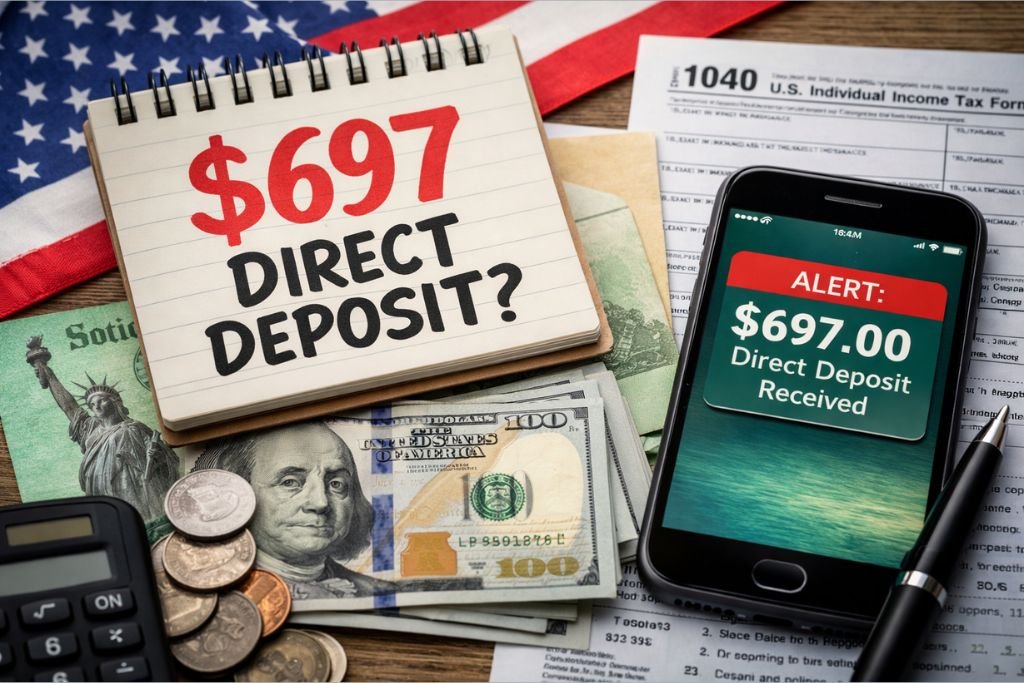
It started like most modern financial rumors do — with a notification.
A headline flashes across a phone screen:
“$697 Direct Deposit Coming Soon — Check Your Eligibility!”
Within hours, social media threads explode. Blog posts multiply. Comment sections fill with hope, confusion, and urgency. Some claim the payment is automatic. Others say you must apply immediately. A few insist it’s part of a secret government relief package.
But here’s the real question:
Is the rumored $697 direct deposit payment real — or just another viral illusion?
Let’s pull back the curtain and uncover what’s actually happening.
The Birth of a Viral Payment
The phrase “rumored $697 direct deposit payment” began circulating through blogs, short-form videos, and reposted articles. The claim was simple but powerful:
A $697 direct deposit would soon be sent to eligible Americans through a federal benefit program.
For many households facing inflation, rising rent, medical bills, and grocery costs, $697 isn’t just a number. It’s relief. It’s breathing room. It’s hope.
And hope spreads fast.
The rumor gained traction because it followed a familiar pattern. Over the past several years, Americans have received legitimate government payments — stimulus checks, child tax credits, Social Security adjustments, and state rebates. So when a new number appears online, it doesn’t feel impossible.
It feels plausible.
That plausibility is what gives rumors power.
Where Did the $697 Figure Come From?
Unlike official stimulus packages passed by Congress, the rumored $697 direct deposit payment does not trace back to a publicly announced bill, federal press conference, or confirmed agency update.
Instead, it appears to originate from:
- Aggregated blog posts
- Click-driven content sites
- Social media resharing
- Misinterpretation of existing benefit amounts
In many cases, the $697 amount seems to be connected to confusion surrounding monthly benefit calculations under programs managed by the Social Security Administration.
However, Social Security benefits are not universal flat payments. They vary significantly based on:
- Lifetime earnings history
- Age at retirement
- Disability status
- Supplemental Security Income (SSI) eligibility
- Cost-of-living adjustments (COLA)
There is no publicly confirmed federal program announcing a new universal $697 direct deposit.
And that distinction matters.
The Role of the IRS and Federal Payment Systems
Whenever rumors about direct deposits surface, attention quickly shifts to the Internal Revenue Service (IRS).
Historically, the IRS has been responsible for distributing:
- Economic Impact Payments (stimulus checks)
- Advance Child Tax Credit payments
- Tax refunds
- Certain federal relief distributions
Each legitimate federal payment followed a clear process:
- Congressional legislation
- Presidential approval
- Official IRS announcement
- Formal payment schedule publication
With the rumored $697 direct deposit payment, none of these steps have occurred.
There has been:
- No bill passed specifying a $697 universal payment
- No IRS press release confirming distribution
- No official government eligibility portal
This absence of verification is a critical red flag.
Why People Believe the Rumor
To understand why the rumored $697 direct deposit payment continues circulating, we need to understand psychology.
1. Financial Stress Creates Urgency
Millions of Americans live paycheck to paycheck. When inflation rises and wages lag behind, even a modest payment can feel life-changing.
A headline promising nearly $700 in direct deposit instantly triggers emotional interest.
2. Past Stimulus Precedent
During the COVID-19 pandemic, federal stimulus checks of $1,200, $600, and $1,400 were distributed. That historical memory makes new payment claims seem realistic.
People think:
“If it happened before, it could happen again.”
3. Algorithm Amplification
Social media platforms reward engagement. Posts that promise money generate clicks, comments, and shares — regardless of accuracy.
The more sensational the headline, the faster it spreads.
The Dangerous Side of Viral Payment Claims
While some rumors are harmless speculation, others carry serious risks.
1. Phishing and Scam Websites
Fraudsters often capitalize on payment rumors by creating fake portals that ask users to:
- Enter Social Security numbers
- Provide bank account details
- Pay “processing fees”
- Download malicious files
These scams look official but are designed to steal data.
2. Identity Theft
Entering personal information into unverified websites can lead to:
- Unauthorized bank withdrawals
- Tax fraud
- Credit damage
- Long-term financial harm
3. False Hope
For families struggling financially, believing in a non-existent payment can delay real financial planning decisions.
False expectations can be emotionally draining.
Is There Any Scenario Where Someone Might Receive $697?
Interestingly, yes — but not universally.
Some individuals may receive payments around $697 depending on:
- SSI calculations
- Disability benefit amounts
- State-level supplemental benefits
- Tax refund totals
However, these payments are:
- Individualized
- Based on eligibility formulas
- Not part of a newly announced nationwide program
The key distinction is this:
A personalized benefit is not the same as a new federal $697 direct deposit for everyone.
How to Verify Payment Claims Safely
Before believing or sharing information about the rumored $697 direct deposit payment, follow these steps:
Check Official Government Websites
Only trust payment confirmations from:
Major federal payments require congressional approval. If no bill exists, skepticism is warranted.
Avoid Urgent “Act Now” Messages
Scams often include phrases like:
- “Claim before midnight!”
- “Limited-time benefit!”
- “Apply immediately to secure funds!”
Government programs do not operate through panic-driven deadlines.
Never Pay to Receive a Government Benefit
Federal payments never require:
- Application fees
- Processing charges
- Gift card verification
If someone asks for payment to release funds, it is fraudulent.
The Pattern of Recurring Payment Rumors
The rumored $697 direct deposit payment is not an isolated case.
Similar claims have circulated about:
- $1,390 deposits
- $2,000 monthly checks
- “Secret” stimulus programs
- “Unclaimed federal funds”
These rumors typically follow the same cycle:
- Viral headline appears
- Blogs repeat the claim
- Social media spreads excitement
- Fact-checkers debunk
- Rumor fades — until the next number appears
The formula changes, but the structure remains the same.
Why Transparent Information Matters
Misinformation erodes trust.
When financial rumors spread unchecked:
- People lose confidence in legitimate programs
- Scam operations become harder to detect
- Public confusion increases
Accurate reporting protects both wallets and peace of mind.
Clear, verified information is more powerful than viral speculation.
Economic Reality vs. Online Hype
There is currently no confirmed federal announcement supporting a universal rumored $697 direct deposit payment.
If such a payment were real, it would include:
- A named legislative act
- Budget allocation details
- Eligibility guidelines
- Payment schedule timeline
Until those components exist, the claim remains exactly what it is:
A rumor.
And in the digital age, rumors travel faster than facts.
What To Do If You See the Claim Online
If you encounter posts about the rumored $697 direct deposit payment:
- Pause before sharing
- Verify through official sources
- Warn others about possible scams
- Protect your financial information
Digital literacy is the strongest defense against misinformation.
The Bigger Lesson Behind the $697 Story
The real story isn’t just about one number.
It’s about how quickly hope can be monetized.
It’s about how algorithms reward emotion over accuracy.
And it’s about how everyday people searching for financial relief can become targets of viral speculation.
The rumored $697 direct deposit payment serves as a reminder:
In the internet era, not every headline is reality.
But every headline shapes perception.
Final Verdict: Is the Rumored $697 Direct Deposit Payment Real?
Based on currently available official information:
- There is no confirmed nationwide $697 direct deposit program.
- No federal legislation has announced such a payment.
- No official IRS or Social Security bulletin verifies it.
Until verified government confirmation exists, the claim should be treated as unsubstantiated.
Stay informed. Stay cautious. And always verify before believing.
For more fact-checked financial updates and deep dives into viral money claims, keep following Infoaxis, where clarity replaces confusion and research replaces rumor.
Read More : Brit Hume Car Accident
Read More : 41x72x43





Leave a Reply