
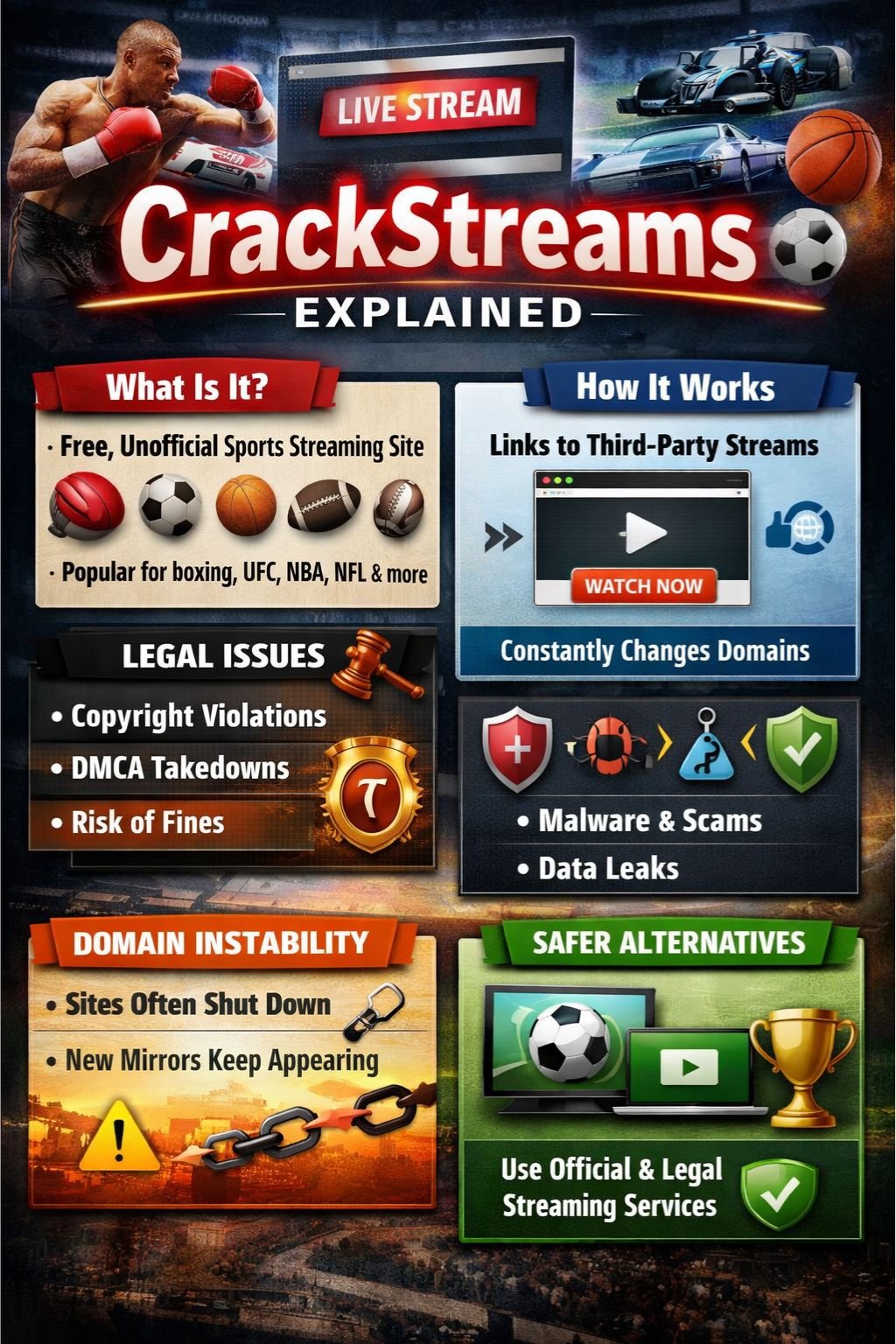
In the digital era of live video and sports entertainment, millions of fans around the world search for ways to watch major events in real time. For some, subscription services and official broadcast rights are expensive and geographically restricted. In this context, a group of unofficial online platforms has emerged to fill demand: among the most widely known of these is CrackStreams, a network of unauthorized sports‑streaming portals that attract millions of users despite legal and security concerns.
This article explores CrackStreams from multiple angles — what it is, how it works, why it is controversial, and what legal and ethical implications surround its use.
You May Also Read About: How to Run a Marathon
What Is CrackStreams?
CrackStreams is not a traditional company or single website. Instead, it is a name commonly associated with a family of unofficial and free sports streaming pages that offer access to live sporting events without requiring authentication or subscription fees. These sites typically provide links to streams for major sports, including boxing, mixed martial arts (UFC), basketball, American football, motorsport, and other high‑profile contests.
While some users describe CrackStreams as a community hub for finding streaming video, others consider it part of a larger ecosystem of sites that redistribute broadcast content without legal rights.
How It Works
CrackStreams essentially functions as an aggregator of links:
- The site lists a schedule of upcoming events.
- Next to each event, multiple stream links are posted.
- Each link points to a third‑party video stream hosted on another server.
- Users click the link and are redirected to the video feed.
Most of the time, CrackStreams does not host the video itself. Instead, it provides a directory of links that lead to embedded video players on anonymous hosting sites. These video streams are often unauthorized re‑broadcasts of official telecasts.
The names and domains associated with CrackStreams can change frequently. Because the site operates outside official channels, owners often shift domains and mirrors to avoid being blocked or taken down by authorities.
Legality and Copyright Implications
One of the most critical aspects to understand about CrackStreams is its legal status. In nearly every country with established copyright law, re‑broadcasting or linking to unauthorized copies of live sporting events is illegal.
Rights to broadcast sports events are usually sold to television networks and streaming services for large sums of money. These official broadcasters enforce their rights through contracts and, when necessary, by legal action against unauthorized distributors.
CrackStreams and similar sites exist in a legal gray area at best and outright violation of copyright laws at worst. Even if the site does not host videos directly, providing easy access to pirated streams can be treated as contributing to infringement.
In many jurisdictions, sports leagues, broadcasters, and copyright enforcement agencies regularly pursue takedowns, domain seizures, or ISP blocking to disrupt unauthorized redistributors. Users of such streams can sometimes face civil penalties or be subject to ISP warnings depending on local law.
User Experience: Convenience vs. Risk
From a user perspective, the appeal of CrackStreams is understandable. Live events can be expensive behind paywalls, geo‑locked, or unavailable in some countries. A free alternative promises easy access without subscriptions.
However, the user experience on CrackStreams is often frustrating and risk‑laden. Typical issues include:
High Volume of Advertisements
The site and linked streams often generate revenue through aggressive advertising. Users may encounter pop‑ups, auto‑play video ads, and misleading “play” buttons that are not the actual video stream.
Cluttered Navigation
Multiple links are often provided for a single event, and many of them may not work, be taken down, or lead to irrelevant or unsafe pages.
Quality and Stability
The quality of unofficial streams is typically lower than official broadcasts. Video resolution may be poor, buffering frequent, and streams may drop unexpectedly.
This combination of intrusive ads and unstable feeds can lead to a frustrating experience for many users.
Security and Privacy Concerns
Perhaps even more important than legality are the cybersecurity and privacy risks associated with CrackStreams and similar streaming directories.
Malicious Advertising
Because these sites generate revenue primarily through ad networks that are unmonitored or poorly regulated, users may be exposed to malicious advertisements. These ads can prompt fake alerts, encourage downloads of unwanted or malicious software, or lead to phishing pages.
Hidden Downloads and Malware
Some streams or links may require users to install video codecs or browser plugins that are, in fact, malware in disguise. Malware can include spyware, ransomware, or cryptomining scripts that run unnoticed in the background.
Tracking and Data Exposure
Without proper security or encryption, these sites can expose user IP addresses, browsing habits, and other sensitive data to trackers or attackers. Using unsecured Wi‑Fi makes these risks even greater.
Users who connect from corporate networks—including schools or workplaces—may face additional penalties if such use violates network policies.
Domain Changes and Clone Sites
Operators of unauthorized streaming sites, including CrackStreams, often find themselves in conflict with copyright enforcement. As a result:
- Domains get shut down or blocked by internet service providers (ISPs)
- New mirror domains appear to replace old ones
- Clones and imitators arise with similar names but unpredictable safety and quality
These mirror websites range in authenticity and can be even more dangerous than the original. Some may be intentionally deceptive designed to mislead users into downloading malware or entering personal information.
For users, this continuous shifting of domains makes it difficult to know which site is the “real” one and which are scams.
Why CrackStreams Became Popular
Despite all the drawbacks, CrackStreams gained popularity for several reasons:
1. Cost Savings
Many sports broadcasts are behind subscription paywalls. A free alternative is attractive, especially in countries where official streams are unavailable or pricey.
2. Global Access
Official streaming rights are often region‑locked. CrackStreams lets users bypass geo‑restrictions — though that does not make it legal.
3. Ease of Use
The site’s simple listing of events and links makes it easy for users to find streams quickly without signing up or logging in.
Ethical Considerations
Using unofficial streams raises broader ethical questions. When a fan watches a pirated feed instead of paying for the official broadcast, the broadcasters and the leagues lose revenue that supports:
- Player salaries
- Production costs
- Grassroots development
- Local and international leagues
Sports organizations have increasingly taken technological and legal measures to protect broadcast rights, including digital fingerprinting of content and takedown requests.
Legal Alternatives for Fans
For fans who want to watch live sports without legal or security risks, there are many legitimate options:
- Official broadcast packages offered by leagues
- Subscription streaming platforms with global or regional rights
- Free legal streams provided by broadcasters in some markets
- Licensed social media streams shared by verified broadcasters
These legal avenues may still have a cost, but they ensure a stable, secure, and high‑quality experience — and support the continued growth of the sport.
Final Thoughts
CrackStreams is part of a broader ecosystem of unauthorized, free sports‑streaming resources that attract users seeking cost‑free access to live events. While it may offer an appealing shortcut, the legal, security, and ethical issues associated with using such services are significant.
Users interested in watching sports online are strongly encouraged to consider official and licensed streaming services, which provide better reliability, safety, and respect for the rights of creators and broadcasters.









Leave a Reply